Queensland's building regulator puts it plainly: the majority of Queensland homes are built on what are termed reactive clay soils, which expand and contract with seasonal weather and site conditions, while sandy sites and rocky terrain are usually not prone to that movement. Engineers design footings to AS 2870, and a footing designed to the standard is intended to accommodate the movement expected for the site's class under normal conditions. Kallangur has both kinds of ground. Wagner's own note on the suburb describes it as varied, from reactive clay pockets to sandy bases, which is exactly the situation in which a class cannot be read off a map of the district. It has to be measured on the block, because the block next door may be the other kind.
The regulator's table shows what is at stake in that measurement. Under normal conditions a Class A sand or rock site is expected not to move; a slightly reactive S site up to 20 millimetres; a moderately reactive M site 20 to 40; the two highly reactive H grades 40 to 60 and 60 to 75; and an extremely reactive E site more than 75, with E sites in South-East Queensland recorded moving 100 to 150 millimetres. A footing designed for the wrong class is either over-built for the site or under-built for the movement, and the second is how cracks in slabs and walls begin. Rain drives the cycle: the Bureau of Meteorology's Brisbane Airport station, the nearest long-record station to Kallangur, averages 1,030.9 millimetres a year, with a February mean of 155.1 millimetres against 31.0 in September, the wet-summer, dry-spring swing that makes a reactive clay swell and shrink.
Kallangur is also being rebuilt around its station. The Moreton Bay Central Priority Development Area, declared in September 2016 and renamed from The Mill at Moreton Bay in July 2025, covers about 460 hectares including the Petrie Town Centre and the land south of the new Kallangur station, and the redevelopment of the former paper mill there includes the University of the Sunshine Coast Moreton Bay campus with new health, retail, commercial and residential development. Its development scheme commenced on 13 October 2025 and Moreton Bay City Council assesses the applications. Around the station that means denser residential and commercial building on ground that has already been cut, filled and built on once, and it means the deeper investigation, geotechnical drilling and sampling at depth with laboratory analysis, that lets an engineer size a larger structure rather than assume a house-slab class across the footprint.
Away from the station the work is the suburb's own housing turning over. With 22.1 per cent of homes already townhouses and 42.9 per cent rented, a common Kallangur job is a townhouse row on a block that held one house, and a common one after that is a pool or an extension behind an established home. The regulator's guide is blunt about what changes the ground under an existing house: trees drawing moisture from the clay, poor surface drainage, leaking plumbing and heavily watered gardens against the footings are the abnormal conditions that turn expected movement into damage, and on H and E sites paving that moves can stress and break pipes, whose leaks then swell the clay under the house. A soil test on an established block is how those conditions get designed for rather than discovered.
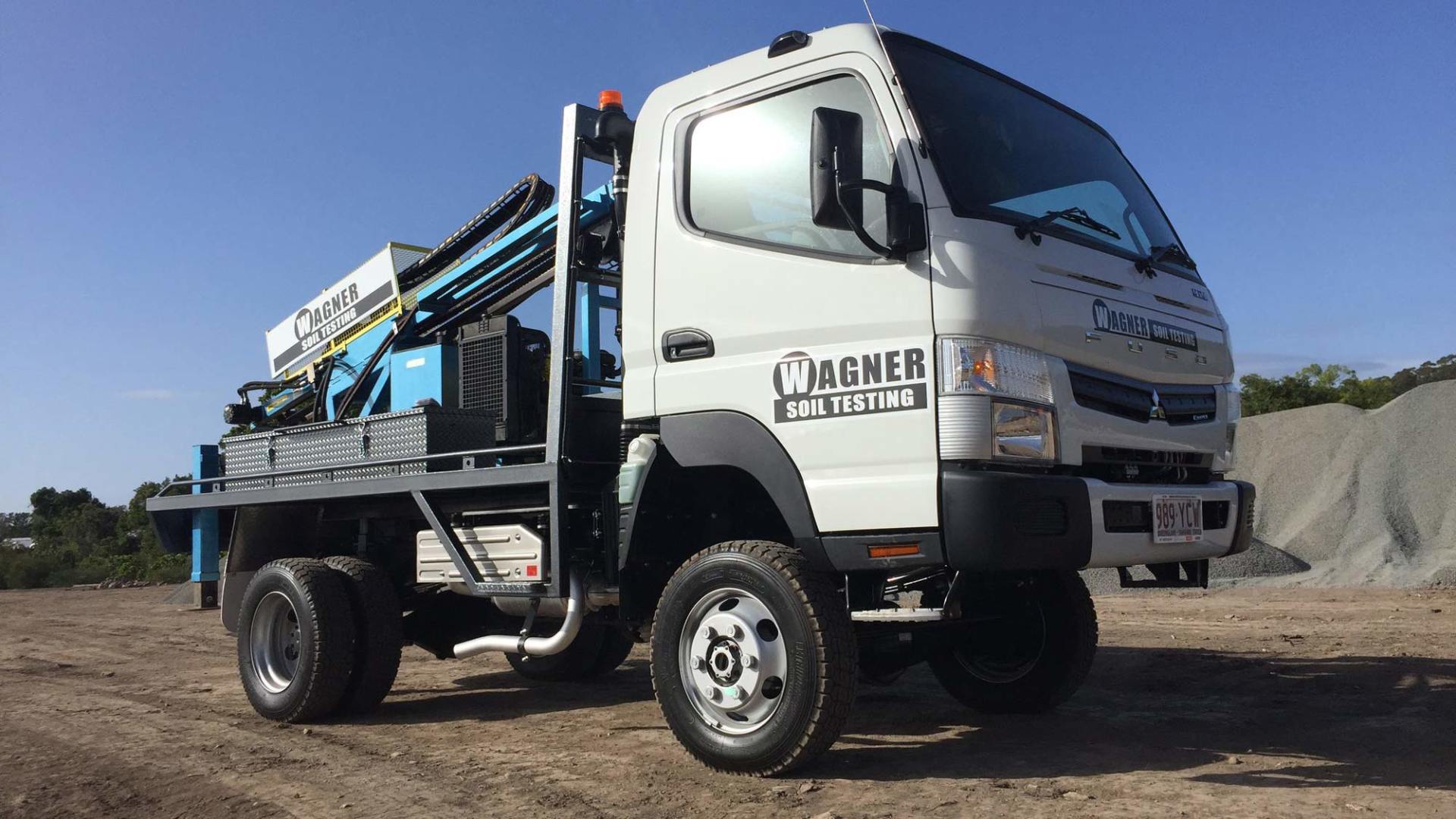
Whatever the project, the method is the one Wagner publishes. We come to your block, drill two boreholes two metres deep near the proposed footing area, run two DCP or bearing-capacity checks beside each hole, and take the samples to our laboratory at Wamuran. For a house, an extension or a townhouse row you get an AS 2870 site classification in one of the six classes, A through to P, that your engineer and certifier design the footings to, and we are happy to talk the result through with your builder or engineer. For a commercial site or a development lot the investigation goes deeper and the report is written for the engineer sizing the structure.
Reactive clay in one street and sand in the next, a station precinct being rebuilt and a suburb of houses turning into townhouse rows: Kallangur is the plain case for testing the block you have rather than the one you assume.