Queensland's building regulator puts it plainly: the majority of Queensland homes are built on what are termed reactive clay soils, which expand and contract with the seasons, while sandy sites and rocky terrain are usually not prone to that movement. Engineers design footings to AS 2870, and a footing designed to the standard is intended to accommodate the movement expected for the site's class under normal conditions. On the Sunshine Coast both kinds of ground occur within a short drive of each other, and sometimes within one suburb, so the class cannot be read off a map of the district. It has to be measured on the block.
Start with the coastal plain. The Queensland Government's soil guidance says coastal areas lower than 5 metres AHD are likely to have acid sulfate soils present, and that they can also lie buried beneath newer soils below 20 metres AHD. Left alone they are harmless. Dug up or drained, the pyrite in them oxidises to sulfuric acid, which the same guidance says can attack concrete and steel, slowly destroying pipes, roads, bridges and building foundations. Many of these soils are unconsolidated estuarine muds and clays with low load-bearing capacity, so foundations built on them may settle unevenly. That is why the Sunshine Coast Planning Scheme 2014 carries an acid sulfate soils overlay code and a flood hazard overlay code among its thirteen overlays. It is also the ground the region's new city centre is being built on: the Maroochydore City Centre Priority Development Area, 60 hectares of central Maroochydore including the former Horton Park Golf Club, declared in July 2013.
Now go inland. The most recent volcanic activity on the Coast, twenty to thirty million years ago, left basalt across the hinterland plateau, and basalt weathers into the rich red and chocolate soils of the Maleny plateau. Those soils are fertile because they are clay, and clay is what moves. The regulator's own table gives the expected range of movement under normal conditions for each AS 2870 class: none for Class A sand and rock, up to 20 millimetres for a slightly reactive S site, 20 to 40 for a moderately reactive M site, 40 to 60 and 60 to 75 for the two highly reactive H grades, and more than 75 millimetres for an extremely reactive E site, with movements of 100 to 150 millimetres recorded in south-east Queensland. The same steep, cleared basalt country is where landslips occur, which is why the planning scheme also carries a landslide hazard and steep land overlay code. Rain drives the cycle: the Bureau of Meteorology's Sunshine Coast Airport station averages 1,492.6 millimetres a year, with a February mean of 217.5 millimetres against 51.1 in September. That wet-summer, dry-spring swing is exactly the seasonal moisture change that makes a reactive clay shrink and swell.
Then there is growth, on the Coast and on the corridor south of it. On 17 July 2026 the state declared the Halls Creek Priority Development Area, 1,231 hectares at Coochin Creek in the Sunshine Coast region, planned for up to 12,000 homes with an early release of about 1,000. South of the Coast in the City of Moreton Bay, the Waraba PDA declared in August 2024 is planned for about 25,000 homes and is bounded to the west by the low hills along Old North Road, the road our laboratory sits on at Wamuran. And around Kallangur station the Moreton Bay Central PDA, about 460 hectares including the former paper mill and the university campus, is filling in the corridor between Brisbane's north and the Coast. Every one of those lots is a first slab with no earlier report to lean on.
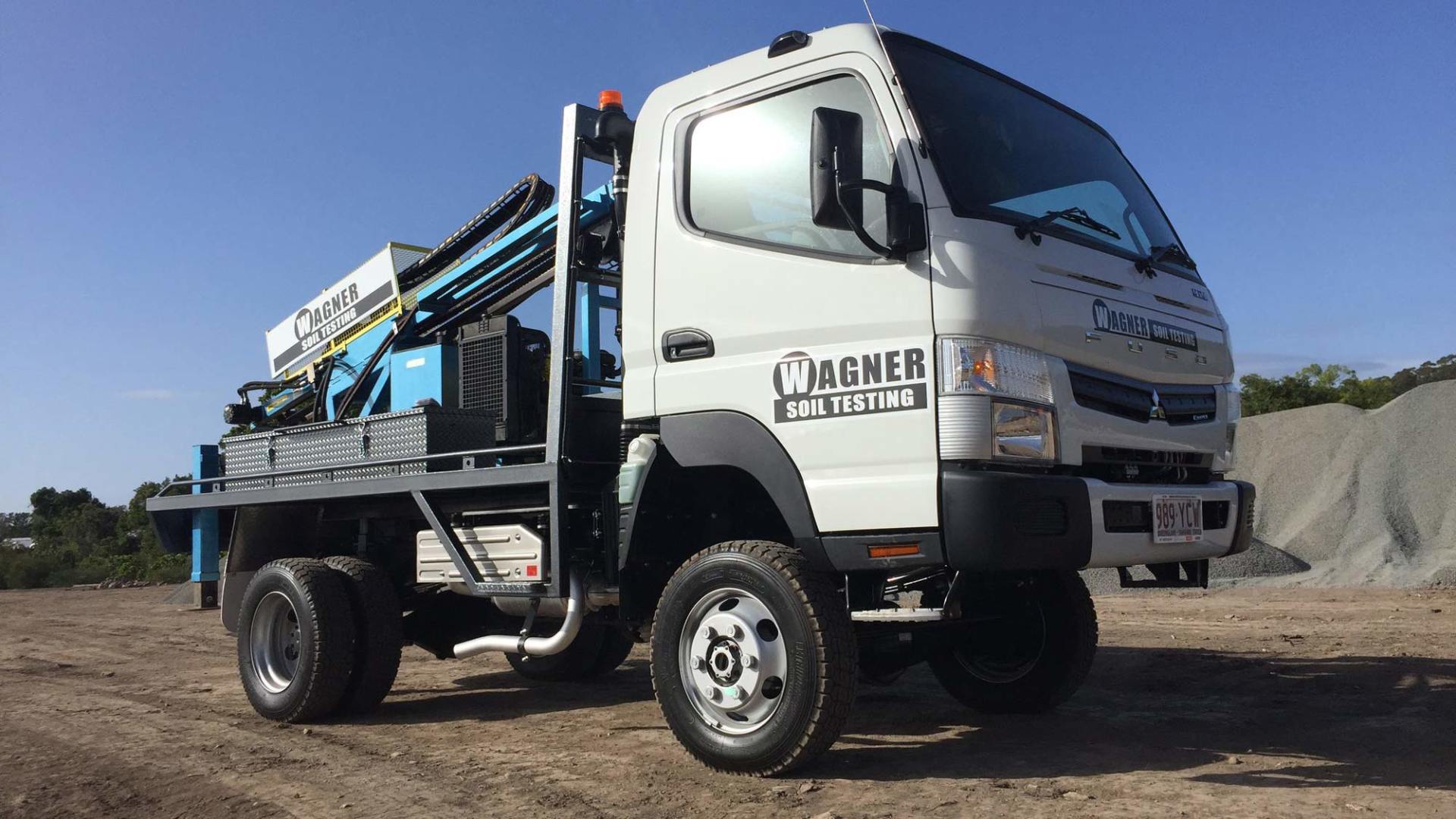
Whatever the ground, Wagner's method is the one its own pages describe. We come to your block, drill two boreholes two metres deep near the proposed footing area, run two DCP or bearing-capacity checks beside each hole, and take the samples to our NATA-accredited laboratory at Wamuran. You get a site classification in one of the six AS 2870 classes, A through to P, that your engineer and certifier design the footings to. Where the ground is low and estuarine, the same visit can include sulphate soil and water analysis, so you know before the concrete pour whether the soil is aggressive to what you are burying in it.
Which page is yours:
- Soil testing in Maroochydore - the Coast's centre and its new CBD, on the low ground where the acid sulfate and bearing questions come before reactivity; 20,629 people, and more than a third of its occupied homes are flats.
- Soil testing in Kallangur - City of Moreton Bay, between Brisbane's northern suburbs and the Coast, beside the Moreton Bay Central PDA; 21,761 people, three quarters of them in separate houses and most of the rest in townhouses.
Sand at the beach, reactive clay on the range and a newly declared growth front at Halls Creek: the Sunshine Coast is the clearest case for testing the block you have rather than the district you are in.