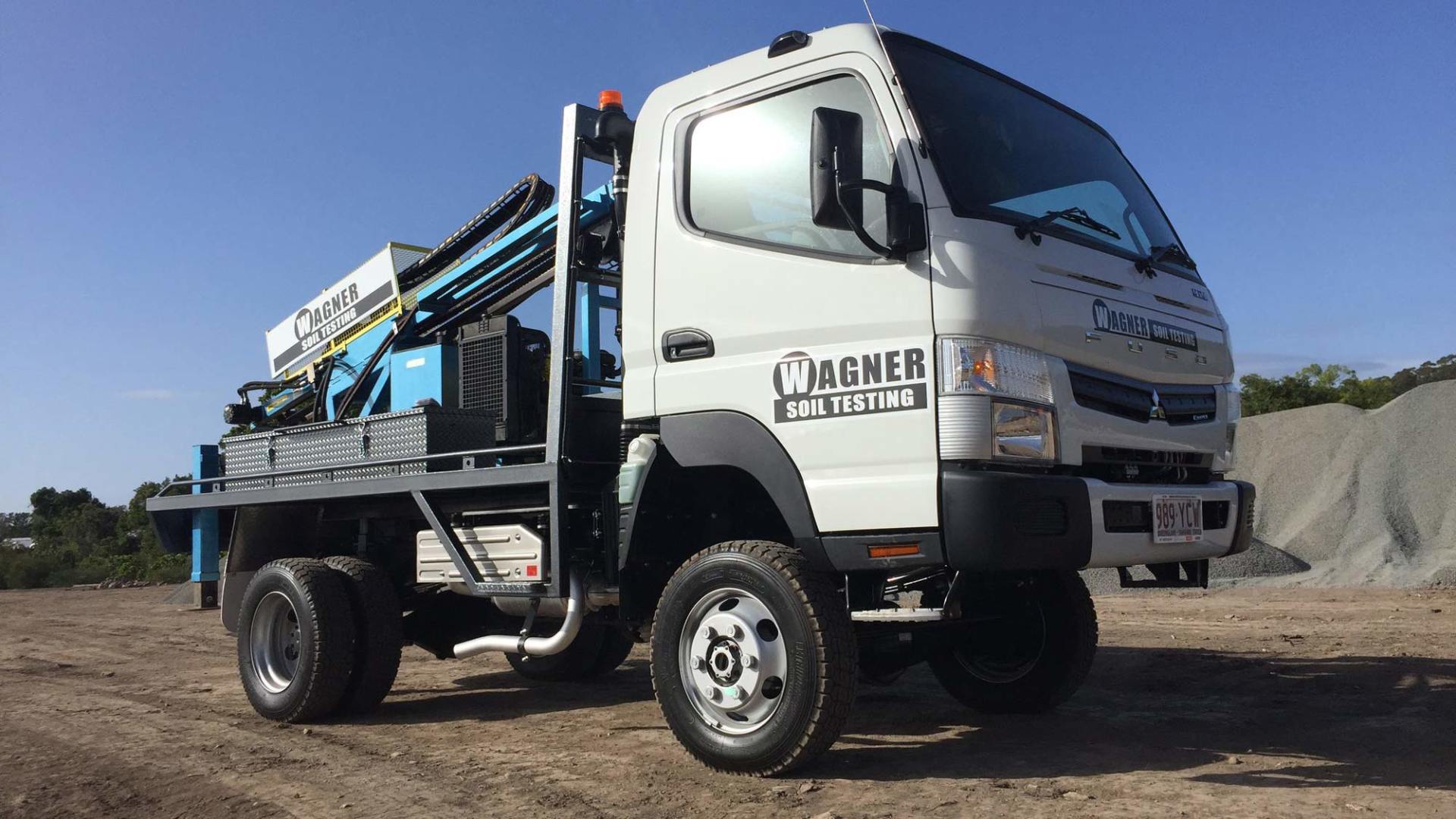
Wagner Soil Testing drilling truck set up for boreholes on a suburban building block

Soil Testing in Kallangur

Comprehensive Soil Testing in Kallangur, From the First Slab to the Pool Behind It

Site-specific soil data for residential, commercial and development projects in the City of Moreton Bay, analysed in a NATA-accredited laboratory a short drive up the road.

Construction projects demand precision, and in Kallangur the precision starts underground. Without a site-specific soil test you risk footings designed for ground you have not measured, and Wagner's own Kallangur article describes the suburb's soil as varied, from reactive clay pockets to sandy bases. Wagner Soil Testing provides AS 2870 site classifications, geotechnical drilling and laboratory analysis for residential, commercial and development projects in Kallangur, with every sample analysed in our NATA-accredited laboratory (No. 15070) at Wamuran, in the same City of Moreton Bay. For results your engineer and certifier can design to, request a quote or call (07) 5496 6715.

Kallangur is a City of Moreton Bay suburb on the corridor between Brisbane's northern suburbs and the Sunshine Coast, and it is younger and more rented than the state around it. At the 2021 Census it held 21,761 people with a median age of 35, against 38 for Queensland, in 8,894 private dwellings. Of the occupied homes, 74.3 per cent were separate houses and 22.1 per cent townhouses, with almost no apartments; 42.9 per cent were rented and only 20.4 per cent owned outright, where the Queensland figures are 33.1 and 29.1 per cent. That is a suburb where the person ordering a soil test is often a builder pricing a townhouse row on a former house block, an investor, or a family adding a pool or an extension to an established home, and the ground under all three is the same varied mix. This page sets out what a test involves for each of them and why it cannot be skipped here.

For the regional picture, Sunshine Coast soil testing is the page above this one; for the Coast's centre, see Soil testing in Maroochydore.

Why it matters here

Site conditions shape the report

Queensland's building regulator puts it plainly: the majority of Queensland homes are built on what are termed reactive clay soils, which expand and contract with seasonal weather and site conditions, while sandy sites and rocky terrain are usually not prone to that movement. Engineers design footings to AS 2870, and a footing designed to the standard is intended to accommodate the movement expected for the site's class under normal conditions. Kallangur has both kinds of ground. Wagner's own note on the suburb describes it as varied, from reactive clay pockets to sandy bases, which is exactly the situation in which a class cannot be read off a map of the district. It has to be measured on the block, because the block next door may be the other kind.

The regulator's table shows what is at stake in that measurement. Under normal conditions a Class A sand or rock site is expected not to move; a slightly reactive S site up to 20 millimetres; a moderately reactive M site 20 to 40; the two highly reactive H grades 40 to 60 and 60 to 75; and an extremely reactive E site more than 75, with E sites in South-East Queensland recorded moving 100 to 150 millimetres. A footing designed for the wrong class is either over-built for the site or under-built for the movement, and the second is how cracks in slabs and walls begin. Rain drives the cycle: the Bureau of Meteorology's Brisbane Airport station, the nearest long-record station to Kallangur, averages 1,030.9 millimetres a year, with a February mean of 155.1 millimetres against 31.0 in September, the wet-summer, dry-spring swing that makes a reactive clay swell and shrink.

Kallangur is also being rebuilt around its station. The Moreton Bay Central Priority Development Area, declared in September 2016 and renamed from The Mill at Moreton Bay in July 2025, covers about 460 hectares including the Petrie Town Centre and the land south of the new Kallangur station, and the redevelopment of the former paper mill there includes the University of the Sunshine Coast Moreton Bay campus with new health, retail, commercial and residential development. Its development scheme commenced on 13 October 2025 and Moreton Bay City Council assesses the applications. Around the station that means denser residential and commercial building on ground that has already been cut, filled and built on once, and it means the deeper investigation, geotechnical drilling and sampling at depth with laboratory analysis, that lets an engineer size a larger structure rather than assume a house-slab class across the footprint.

Away from the station the work is the suburb's own housing turning over. With 22.1 per cent of homes already townhouses and 42.9 per cent rented, a common Kallangur job is a townhouse row on a block that held one house, and a common one after that is a pool or an extension behind an established home. The regulator's guide is blunt about what changes the ground under an existing house: trees drawing moisture from the clay, poor surface drainage, leaking plumbing and heavily watered gardens against the footings are the abnormal conditions that turn expected movement into damage, and on H and E sites paving that moves can stress and break pipes, whose leaks then swell the clay under the house. A soil test on an established block is how those conditions get designed for rather than discovered.

Whatever the project, the method is the one Wagner publishes. We come to your block, drill two boreholes two metres deep near the proposed footing area, run two DCP or bearing-capacity checks beside each hole, and take the samples to our laboratory at Wamuran. For a house, an extension or a townhouse row you get an AS 2870 site classification in one of the six classes, A through to P, that your engineer and certifier design the footings to, and we are happy to talk the result through with your builder or engineer. For a commercial site or a development lot the investigation goes deeper and the report is written for the engineer sizing the structure.

Reactive clay in one street and sand in the next, a station precinct being rebuilt and a suburb of houses turning into townhouse rows: Kallangur is the plain case for testing the block you have rather than the one you assume.

On the ground here

Common local challenges

The challenge

Reactive clay pockets and sandy bases in the same suburb

Wagner's own note on Kallangur describes its ground as varied, from reactive clay pockets to sandy bases, and the regulator's guide says most Queensland homes sit on reactive clay while sandy sites usually do not move. Which one a given block is cannot be read from the street.

A class assumed from the neighbour's report can be wrong by two grades, and the regulator's table puts the difference between an M site and an H2 at up to 55 millimetres of expected movement.

Local clay can be reactive, and a highly reactive class is not unusual in clay country, but the class is measured, never assumed: two two-metre boreholes near the proposed footing area, two bearing tests beside each, and laboratory analysis at Wamuran give your engineer the block's own class to design to.

The challenge

Townhouse rows on blocks that held one house

At the 2021 Census 22.1 per cent of Kallangur's occupied homes were townhouses and 42.9 per cent were rented, so infill on established blocks is a large share of the building here. A former house block has been cut, filled, gardened and plumbed once already.

A row on one shared slab spreads its load across ground that can change from one end of the block to the other, and old fill, old garden beds and old service trenches are all there under the new footprint.

We test the block as it presents on the day, boreholes through any fill to the natural ground beneath, and the classification reflects what the slab will actually bear on. Fill depth is in the report because the engineer needs it, and a longer footprint gets the extra test locations it needs.

The challenge

Building beside the Moreton Bay Central PDA

The Priority Development Area around Kallangur station, about 460 hectares declared in 2016, is turning the former paper mill and the land south of the station into a university campus with health, retail, commercial and residential development. Its development scheme commenced on 13 October 2025 and Moreton Bay City Council assesses applications against it.

Denser residential and commercial buildings near the station are designed from deeper ground data than a house block, on land that has been worked before, and the reports have to be written to what that assessment expects.

We provide the site investigation, geotechnical drilling and sampling at depth, laboratory analysis, borehole logs and bearing results, that the engineer designs from and the certifier relies on, and we produce the soil report rather than assess the application.

The challenge

Pools and retaining walls behind established homes

Wagner's Kallangur note lists a slab, a swimming pool and a retaining wall as the three jobs that need the soil data, and with 74.3 per cent of the suburb in separate houses, the pool and the wall are the common second project on a block.

The regulator's guide says design for site conditions, retaining walls, swimming pools and future structures should all be considered when preparing a site for surface-water flow, and that a leak from plumbing wets the clay under the house and makes it swell. A pool is both a structure and a potential leak, and a retaining wall holds back the very soil the classification is about.

The same boreholes and bearing tests classify the ground the pool shell or the wall will bear against, and the report gives the engineer what the guide says to seek from one: the surface falls that allow for the site's potential movement and the correct connection of paths and footings.

The challenge

Pipes and leaks on reactive ground

The regulator's guide notes that on H and E sites movement in paths and paving can stress pipes and inspection openings and break them, and that the resulting leaks wet the clay under the house and cause movement and damage as it swells.

On reactive ground a leak is not just a plumbing problem; it is a cause of the footing movement the classification was meant to design out.

Our pipe testing checks how well pipes are carrying their load and whether the soil around them is corroding them, with water and sulphate soil analysis where the ground calls for it, and our CCTV crawler puts a camera inside the pipe so the fault is seen rather than guessed, with reporting to the WSA05-2013 code.

The challenge

Extensions, gardens and trees changing the ground under a house

The regulator's guide lists the abnormal conditions that turn expected movement into damage on reactive clay: the effect of trees, poor surface drainage, leaking plumbing and heavily watered garden beds against the house. Tree roots can remove moisture from the clay under the footings and cause subsidence as the clay shrinks, and a root system can spread as far as the tree is tall.

An extension ties new footings to old ones, and if the two sit on ground with different moisture regimes, the join is where the cracking shows.

A classification on the extension's footprint, taken beside the existing house, tells the engineer how the new footings should relate to the old ones, and the report notes the site conditions the guide says to plan around so they are designed for rather than discovered.

Our services

What we offer in Kallangur

Residential Soil Testing

An AS 2870 site classification for a new home, an extension or a townhouse row, from two two-metre boreholes and on-site bearing tests, analysed in our NATA-accredited laboratory for your engineer's slab and footing design.

In a suburb described as reactive clay pockets and sandy bases, the class is measured on the block, never assumed from the neighbour's report.

Learn more

Commercial Soil Testing

Site investigation for commercial, retail, industrial and multi-unit buildings: geotechnical drilling and sampling at depth, laboratory analysis and a report your engineer sizes the structure from.

Around Kallangur station the Moreton Bay Central PDA is bringing denser commercial and residential building onto land that has been worked before.

Ask about commercial testing

Development Projects

Investigation for subdivisions, infrastructure and larger builds: borehole logs, samples and bearing results written for the engineer and the assessing authority.

Inside the Moreton Bay Central PDA, Moreton Bay City Council assesses applications against a development scheme that commenced in October 2025; we supply the soil report it is designed from, not the assessment.

Ask about development work

Pipe Testing

Testing how well your pipes carry their load and whether the surrounding soil is corroding them, with suggestions where the soil is the cause of the problem.

On reactive ground a leak is a cause of footing movement, not just a plumbing fault, so the pipe and the soil around it are tested together.

Learn more

CCTV Pipe Inspection

A camera crawler inside the pipe so the fault is seen rather than guessed, with a sample taken from the problem spot and reporting to the WSA05-2013 code.

For established houses and townhouse rows where a buried pipe can be leaking under the slab long before anything shows at the surface.

Learn more

Laboratory Analysis

Water analysis, sulphate soil testing and other laboratory analysis on samples from your site, run in the NATA-accredited Wamuran laboratory.

Where a pool, a low wet corner of the block or buried concrete raises the question of what the water and the soil will do to it.

Ask about lab testing
Why us

Accredited, and accountable

What can be checked about this business is what it publishes and what the public registers hold. Wagner Soil Testing operates a NATA-accredited laboratory, Accreditation No. 15070, at 296 Old North Road, Wamuran, in the same City of Moreton Bay as Kallangur, and describes itself as a family business since 2004 with more than twenty years in geotechnical and soil testing. The ABN 49 416 679 791 is held by the trustee for The Wagner Family Trust. The business publishes South East Queensland among its service areas, and its site classification method as two two-metre boreholes near the proposed footing area with two DCP or bearing-capacity checks beside each, followed by laboratory analysis. Its CCTV inspection uses a Rovion iPek crawler system with reporting to the WSA05-2013 code. Queensland's building regulator is the QBCC, which keeps a free public register of licence holders; before you engage any contractor for building work in Kallangur, including anyone who classifies your site, look them up there.

Coverage

Where we work

Good to know

Frequently asked questions

Do I need a soil test to build in Kallangur?

In practice, yes. Queensland's building regulator explains that engineers design footings to AS 2870 and that the design is matched to the site's classification, the measured expectation of how much the ground will move. Your engineer or certifier confirms what your approval needs, and the classification is what feeds that design. In Kallangur the added reason is the ground itself: reactive clay pockets and sandy bases in one suburb mean the block next door is no guide to yours.

What is included in a Wagner soil test?

A site visit with borehole drilling, two boreholes two metres deep near the proposed footing area, with two DCP or bearing-capacity checks beside each hole; laboratory analysis of the samples at our NATA-accredited Wamuran laboratory; and a site classification report giving your block's AS 2870 class, from A through to P, that your engineer designs the footings to. We are happy to talk the result through with your builder or engineer so the design fits the site. For a commercial site or a development lot the investigation goes deeper, with sampling at depth and a report written for the engineer sizing the structure.

Is Kallangur clay or sand?

Both, and that is the point. Wagner's own Kallangur article describes the suburb as varied, from reactive clay pockets to sandy bases, and the regulator's guide says most Queensland homes sit on reactive clay while sandy sites are usually not prone to seasonal movement. Local clay can be reactive, and a highly reactive class is not unusual in clay country, but no one can tell you your block's class from the street. We drill two boreholes on your lot, run bearing tests beside them, and classify from the laboratory result.

I am building near Kallangur station, in the Moreton Bay Central PDA. What changes?

The Priority Development Area around the station, about 460 hectares including the Petrie Town Centre and the land south of the new Kallangur station, was declared in September 2016 and renamed from The Mill at Moreton Bay in July 2025. Its development scheme commenced on 13 October 2025, and Moreton Bay City Council assesses applications against it. Denser buildings there are designed from deeper ground data than a house block, on land that has been cut, filled and built on before. We provide the site investigation and laboratory analysis, with borehole logs, samples and bearing results, and we produce the soil report rather than assess the application.

Does a pool or a retaining wall need a soil test?

It needs the same soil data a slab does. Wagner's Kallangur note lists a slab, a swimming pool and a retaining wall as the three jobs that call for it, and the regulator's guide says retaining walls, swimming pools and future structures should all be considered when a site is prepared, with an engineer consulted on the surface falls that allow for the site's potential movement. A pool shell bears on the ground and can leak into it; a retaining wall holds back the very soil the classification describes. The boreholes and bearing tests give your engineer what both need.

How much does a soil test cost in Kallangur, and how long does it take?

Wagner does not publish a set price or a set turnaround. The cost depends on the block, its access, the number of test locations, and whether it is a house classification or a deeper commercial investigation. For a price and a timeframe on your specific block, contact us with the address and what you are building; we would rather quote your actual site than give you a number that does not fit it.

Do you have an office in Kallangur?

No. Our only office and laboratory is the NATA-accredited laboratory at 296 Old North Road, Wamuran, west of Caboolture in the same City of Moreton Bay, and we service Kallangur from there. The boreholes and bearing tests are carried out on your block, and every sample is analysed in our accredited laboratory rather than sent elsewhere.

Get in touch

Do not build on guesswork in a suburb where the next street can be a different soil. Whether it is a first home, a townhouse row, a pool behind an established house or a commercial site near the station, get the classification before the footings are designed: request a soil test quote with the address and what you are building, or call (07) 5496 6715.

Service Area

South East QLD, Gold Coast, Sunshine Coast, Toowoomba

Hours

Mon - Fri

Sat - Sun
7:00 AM - 5:00 PM

Appointment Only

Contact

Copyright © 2025, Website design and hosting by Smart Local

Privacy Policy

Privacy Policy

Revised: May 1, 2021

Introduction

Your information privacy is important to us. We provide this Privacy Policy to explain how we collect, use, protect, and disclose information and data, including when you use the website on which this policy is posted (“Site”) and related services offered through the Site (“Services”). This Privacy Policy applies to all users of the Site and Services. 

BY USING THE SITE OR SERVICES, YOU ARE CONSENTING TO THIS PRIVACY POLICY. PLEASE READ IT CAREFULLY.

1. Personal Information We Collect

We may collect the following categories and types of “Personal Information”: 

  • Contact Information: your first and last name, mailing address, email address, and phone number; 
  • Other identifying information: IP address, social media usernames, passwords and other security information for authentication and access;
  • Financial Information: credit card, debit card and bank account information; 
  • Demographic information: gender, age, employment information and salary information; 
  • Geolocation data; 
  • Internet or other electronic activity: your browsing and click history, including information about how you navigate within our Site and Services and which elements of our Site and Services you use the most; 
  • Commercial information: products or services purchased or viewed on our Site; 
  • Audio and visual information: your videos and photos; 
  • Inferences drawn from the categories described above in order to create a profile about you to reflect your preferences, characteristics, behaviour and attitude; and
  • Other information: some information we collect might not be included in this list. It really depends on the service or product we’re offering.

2. How We Use Personal Information

We may use your Personal Information for the following categories of use:

  • Transactional Purposes: We may use your contact information, financial information, and commercial information to:
    - Receive, process, confirm, send and track your order, subscription or registration; 
    - Communicate with you about your order, subscription or registration; and
    - Process any subscription or registration you make to one of our Services.
  • Analytical Purposes: We may use your other identifying information, internet activity and browsing history, commercial information, demographic information, and geolocation data to analyse preferences, trends and statistics.
  • Marketing and Promotional Purposes: We may use your contact information, commercial information, demographic information, internet or other electronic activity, geolocation data and inferences to:
    - Inform you of our new products, services and offers;
    - Provide you with targeted advertising;
    - Run competitions and promotions;
    - Provide you with our loyalty program including earning points and awarding and redeeming certificates; and
    - Provide you with other information from and about us, including personalised marketing communications. 
  • Maintenance and Improvement of the Site and Services: We may use your contact information, commercial information, and internet activity and browsing history to:
    - Provide you with the Site and Services, including to send you alerts about your account;
    - Handle your customer services requests; and
    - Help us diagnose technical and service problems and administer our stores, the Site, and the Services.
  • Review and content creation purposes: We may use your contact information, commercial information, and audio and visual information to enable reviews of our products and to display content that you have created and allowed us to display on our Site and Services and on social media.
  • Security and Fraud Prevention: We may use your contact information, other identifying information, commercial information, internet activity and browsing history, and inferences to protect the Site and services, our Company, and others and to prevent fraud, theft and misconduct.
  • Legal Requirements and Other Purposes: We may use your personal information to comply with legal requirements or when necessary to provide to our lawyers, accountants or other advisors. We may also use your personal information for other purposes for which you have consented to, or for other purposes as permitted by law. This may include for a secondary purpose that is related to a purpose for which we collected it, and for which you would reasonably expect us to use your information for. 

Without the use of your information, however, we may not be able to provide you the products, services, or information you request.

3. Sources of Personal Information

We may collect Personal Information from the following sources:

  • We collect information directly from you. We may collect contact, demographic and financial information directly from you, including when you fill out a form on our Site, sign up for communications from us, or ask us to contact you. The information that we collect depends on the nature of your interactions with us.
  • We collection information from third-party sources. We may also collect information about you from third-party sources, including any information you make publicly available on social media platforms or other online or offline resources, or when you give us consent to link your account to a third-party service or provider.
  • We collect information from you passively. We may collect internet or other electronic activity passively using tools like browser cookies. This activity is further described in the Cookies and Advertising and Online Tracking sections below.

4. Categories of Third Parties We Share Personal Information With

Service Providers
From time to time, we may establish a business relationship with other businesses whom we believe trustworthy and have privacy practices are consistent with ours (“Service Providers”). For example, we may contract with Service Providers to provide certain services, such as hosting and maintenance, data storage and management, and marketing and promotions. We only provide our Service Providers with the information necessary for them to perform these services on our behalf.

Our Affiliates 
We may share Personal Information with businesses controlling, controlled by, or under common control with us.

Corporate Transactions
If we merge, are acquired, or are sold, or in the event of a transfer of some or all of our assets, we may disclose or transfer Personal Information in connection with such transaction. You will have the opportunity to opt out of any such transfer if, in our discretion, it will result in the handling of your Personal Information in a way that differs materially from this Privacy Policy.

Compliance with Laws and Law Enforcement
We cooperate with government and law enforcement officials and private parties to enforce and comply with the law. We may disclose Personal Information and any other information about you to government or law enforcement officials or private parties if, in our discretion, we believe it is necessary or appropriate in order to respond to legal requests (including court orders and subpoenas), to protect the safety, property, or rights of our company or of any third party, to prevent or stop any illegal, unethical, or legally actionable activity, or to comply with the law.

5. Cookies

We may use cookies (a small text file placed on your computer to identify your computer and web browser) and may use anonymous identifiers (a random string of characters that is used for the same purposes as a cookie). We may use cookies and other similar technologies to analyse use of and improve the Site and Services and as described in the Advertising and Online Tracking Section of this Privacy Policy. Most web browsers are initially set up to accept cookies. You can reset your web browser to refuse all cookies or to indicate when a cookie is being sent, however, certain features of the Site or Services may not work if you delete or disable cookies. Some of our Service Providers (defined below) may use their own cookies, anonymous identifiers, or other tracking technology in connection with the services they perform on our behalf.

We may use Google Analytics on the Site and Services to analyse how users use the Site and Services, and to provide advertisements to you on other websites. For more information about how to opt out of having your information used by Google Analytics, visit https://tools.google.com/dlpage/gaoptout/.

6. Advertising and Online Tracking

We may allow third-party companies to serve ads and collect certain information when you visit the Site and Services. These companies may use certain information (e.g. click stream information, web browser type, time and date, subject of advertisements clicked or scrolled over) during your visits to the Site and other websites in order to provide advertisements about goods and services likely to be of interest to you. These companies typically use a cookie to collect this information. Our systems do not recognise browser “Do Not Track” signals, but several of our Service Providers who utilise these cookies on our Site enable you to opt out of targeted advertising practices. To learn more about these advertising practices or to opt out of this type of advertising, you can visit www.networkadvertising.org or www.aboutads.info/choices/. We also provide you with additional tools to opt out of marketing from us. You can learn about this in the “Managing Your Information Preferences” section of this Privacy Policy.

7. Managing Your Information Preferences

You can opt out of receiving marketing e-mails from us by following the link provided at the bottom of all marketing e-mails you receive from us. You are able to opt out of receiving marketing e-mails from us, however, you cannot opt out of receiving all e-mails from us, such as e-mails about the status of your account.

8. Be Careful When You Share Information with Others

Please be aware that whenever you share information on any public area of the Site or Services, that information may be accessed by others. In addition, please remember that when you share information in any other communications with third parties, that information may be passed along or made public by others. This means that anyone with access to such information can potentially use it for any purpose, including sending unsolicited communications.

9. Security

We maintain physical, electronic, and procedural safeguards to protect the confidentiality and security of information transmitted to us. However, no data transmission over the Internet or other network can be guaranteed to be 100% secure. As a result, while we strive to protect information transmitted on or through the Site or Services, we cannot and do not guarantee the security of any information you transmit on or through the Site or Services, and you do so at your own risk.

10. Links

Our Site and Services may contain links to other websites or allow others to send you such links. A link to a third party’s website does not mean that we endorse it or that we are affiliated with it. We do not exercise control over third-party websites. You access such third-party websites or content at your own risk. You should always read the privacy policy of a third-party website before providing any information to the website.

11. Overseas Transfers

Please be aware that your Personal Information and communications may be transferred to and maintained on servers or databases located outside of Australia. Please be advised that we may process and store information overseas, including in the United States.

12. Privacy Policy Changes

We may change this Privacy Policy from time to time. If we decide to change this Privacy Policy, we will inform you by posting the revised Privacy Policy on the Site. Those changes will go into effect on the “Revised” date shown in the revised Privacy Policy. By continuing to use the Site or Services, you are consenting to the revised Privacy Policy.

13. Access and Correction

If you would like to access or correct your information in our records, please contact us on the contact information available on the Site. We will promptly respond to your request.

14.  How to Contact Us / Complaints

If you have any questions regarding this privacy policy or concerns about the management of your personal information, you may contact us at the contact information available on the Site. 

We will aim to investigate and resolve your complaint as soon as possible, usually within 30 days of receiving it. If you are not satisfied with our response, you may lodge a formal complaint with the Office of the Australian Information Commissioner (https://www.oaic.gov.au/)

PLEASE PRINT A COPY OF THIS PRIVACY POLICY FOR YOUR RECORDS AND PLEASE CHECK THE SITE FREQUENTLY FOR ANY CHANGES.