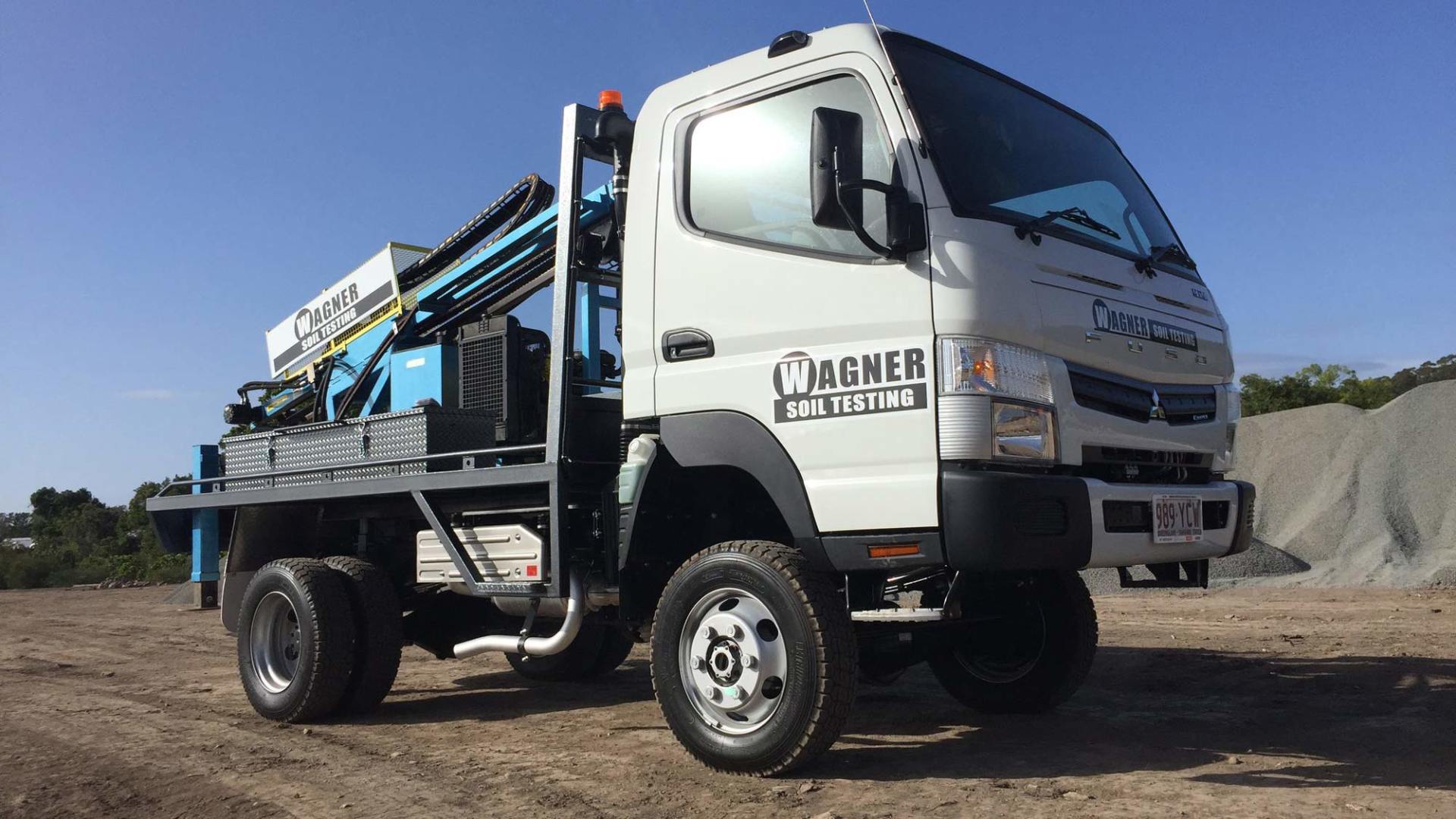
Wagner Soil Testing drilling truck set up for boreholes on a residential building block

Sunshine Coast Soil Testing

Soil Testing Across the Sunshine Coast, From the Beach to the Hinterland

NATA-accredited site classifications, geotechnical drilling, effluent design and pipe testing, with area pages for Maroochydore and Kallangur.

The Sunshine Coast is not one kind of ground. Along the beaches and the river mouths it is sand and estuarine sediment on a low coastal plain; a few kilometres inland it climbs onto ranges where old lava flows have weathered into deep red clay and the slopes are steep enough to carry a landslide overlay. Which of those your block sits on decides what a soil test is looking for. Wagner Soil Testing is a NATA-accredited laboratory (No. 15070) at Wamuran, a family business since 2004, and the Sunshine Coast is one of the service areas it publishes. This page explains how the ground changes across the region and what that means for your footings, then points you to the page for your area: Maroochydore on the Coast, and Kallangur in the City of Moreton Bay on the way up from Brisbane.

This is the regional starting point, and it sits above two area pages. If your block is in Maroochydore or Kallangur, go straight to the page written for it: Soil testing in Maroochydore or Soil testing in Kallangur. Everywhere else on the Coast, from Caloundra and the Kawana strip through Buderim and the Maroochy River plain to Coolum and the hinterland towns, the same process applies and the quote form takes any address.

The reason the region gets more than one page is that its ground and its housing both change sharply over short distances. At the 2021 Census the Sunshine Coast local government area held 342,541 people in 148,638 private dwellings, and of the occupied homes 73.1 per cent were separate houses, 13.0 per cent townhouses and 12.8 per cent flats. Maroochydore does not look like that average: 36.6 per cent of its occupied homes are flats and 42.1 per cent are rented. Kallangur, in the City of Moreton Bay, is the opposite shape, with 74.3 per cent separate houses and 22.1 per cent townhouses and almost no apartments. A slab for a townhouse row on a low coastal plain and a slab for a house on a clay ridge are designed from different soil evidence, and that is what each page is about.

Why it matters here

Site conditions shape the report

Queensland's building regulator puts it plainly: the majority of Queensland homes are built on what are termed reactive clay soils, which expand and contract with the seasons, while sandy sites and rocky terrain are usually not prone to that movement. Engineers design footings to AS 2870, and a footing designed to the standard is intended to accommodate the movement expected for the site's class under normal conditions. On the Sunshine Coast both kinds of ground occur within a short drive of each other, and sometimes within one suburb, so the class cannot be read off a map of the district. It has to be measured on the block.

Start with the coastal plain. The Queensland Government's soil guidance says coastal areas lower than 5 metres AHD are likely to have acid sulfate soils present, and that they can also lie buried beneath newer soils below 20 metres AHD. Left alone they are harmless. Dug up or drained, the pyrite in them oxidises to sulfuric acid, which the same guidance says can attack concrete and steel, slowly destroying pipes, roads, bridges and building foundations. Many of these soils are unconsolidated estuarine muds and clays with low load-bearing capacity, so foundations built on them may settle unevenly. That is why the Sunshine Coast Planning Scheme 2014 carries an acid sulfate soils overlay code and a flood hazard overlay code among its thirteen overlays. It is also the ground the region's new city centre is being built on: the Maroochydore City Centre Priority Development Area, 60 hectares of central Maroochydore including the former Horton Park Golf Club, declared in July 2013.

Now go inland. The most recent volcanic activity on the Coast, twenty to thirty million years ago, left basalt across the hinterland plateau, and basalt weathers into the rich red and chocolate soils of the Maleny plateau. Those soils are fertile because they are clay, and clay is what moves. The regulator's own table gives the expected range of movement under normal conditions for each AS 2870 class: none for Class A sand and rock, up to 20 millimetres for a slightly reactive S site, 20 to 40 for a moderately reactive M site, 40 to 60 and 60 to 75 for the two highly reactive H grades, and more than 75 millimetres for an extremely reactive E site, with movements of 100 to 150 millimetres recorded in south-east Queensland. The same steep, cleared basalt country is where landslips occur, which is why the planning scheme also carries a landslide hazard and steep land overlay code. Rain drives the cycle: the Bureau of Meteorology's Sunshine Coast Airport station averages 1,492.6 millimetres a year, with a February mean of 217.5 millimetres against 51.1 in September. That wet-summer, dry-spring swing is exactly the seasonal moisture change that makes a reactive clay shrink and swell.

Then there is growth, on the Coast and on the corridor south of it. On 17 July 2026 the state declared the Halls Creek Priority Development Area, 1,231 hectares at Coochin Creek in the Sunshine Coast region, planned for up to 12,000 homes with an early release of about 1,000. South of the Coast in the City of Moreton Bay, the Waraba PDA declared in August 2024 is planned for about 25,000 homes and is bounded to the west by the low hills along Old North Road, the road our laboratory sits on at Wamuran. And around Kallangur station the Moreton Bay Central PDA, about 460 hectares including the former paper mill and the university campus, is filling in the corridor between Brisbane's north and the Coast. Every one of those lots is a first slab with no earlier report to lean on.

Whatever the ground, Wagner's method is the one its own pages describe. We come to your block, drill two boreholes two metres deep near the proposed footing area, run two DCP or bearing-capacity checks beside each hole, and take the samples to our NATA-accredited laboratory at Wamuran. You get a site classification in one of the six AS 2870 classes, A through to P, that your engineer and certifier design the footings to. Where the ground is low and estuarine, the same visit can include sulphate soil and water analysis, so you know before the concrete pour whether the soil is aggressive to what you are burying in it.

Which page is yours:

  • Soil testing in Maroochydore - the Coast's centre and its new CBD, on the low ground where the acid sulfate and bearing questions come before reactivity; 20,629 people, and more than a third of its occupied homes are flats.
  • Soil testing in Kallangur - City of Moreton Bay, between Brisbane's northern suburbs and the Coast, beside the Moreton Bay Central PDA; 21,761 people, three quarters of them in separate houses and most of the rest in townhouses.

Sand at the beach, reactive clay on the range and a newly declared growth front at Halls Creek: the Sunshine Coast is the clearest case for testing the block you have rather than the district you are in.

On the ground here

Common local challenges

The challenge

Acid sulfate ground on the low coastal plain

Around 35,000 years ago the sea stood higher and swamps covered much of what is now the coastal plain; newer soil has since been washed over them, which is why the Queensland Government says coastal areas lower than 5 metres AHD are likely to have acid sulfate soils and that they can be buried below 20 metres AHD. Undisturbed, the pyrite in them is harmless. Excavated or drained, it oxidises to sulfuric acid.

The state's guidance says the acid can attack concrete and steel, slowly destroying pipes and building foundations, and that these unconsolidated estuarine muds have low load-bearing capacity, so footings on them can settle unevenly and crack. The Sunshine Coast Planning Scheme 2014 carries an acid sulfate soils overlay code for exactly this ground.

Our boreholes show what is actually under the block and how deep the soft material runs, and our laboratory can run sulphate soil and water analysis on the samples so your engineer knows whether the ground is aggressive to buried concrete and pipes. We supply the soil evidence; how the overlay is addressed in your approval is a question for your planner and engineer, and we say so rather than pretend otherwise.

The challenge

Reactive clay on the hinterland ranges

Basalt from the Coast's last volcanic period weathers into deep red and chocolate clay soils across the hinterland plateau, and the regulator's guide says the majority of Queensland homes sit on reactive clay that swells when wet and shrinks when dry. The Sunshine Coast Airport's February rainfall mean of 217.5 millimetres against 51.1 in September is the seasonal swing that drives it.

The expected movement under normal conditions rises with the class, from 20 to 40 millimetres on an M site to 60 to 75 on an H2 and more than 75 on an E, and the regulator notes E sites in south-east Queensland moving 100 to 150 millimetres. Footings that are not designed for the block's actual class are how that movement ends up as cracks in slabs and walls.

Local clay can be reactive, and a highly reactive class is not unusual in clay country, but the class is measured, never assumed. Two two-metre boreholes near the proposed footing area, two bearing tests beside each, and laboratory analysis at Wamuran give your engineer the block's own class to design to.

The challenge

Steep blocks under the landslide hazard and steep land overlay

Slips on the hinterland's basalt soils come from long-term weathering weakening the soil, from the loss of the trees that bound it and drew water out of it, and from groundwater pressure building within the slope. The planning scheme maps the ground where this is a live question under its landslide hazard and steep land overlay code.

A house on a mapped slope is assessed against that overlay, and the engineer doing the stability work needs to know what the slope is made of at depth, not just what it looks like from the driveway.

Our geotechnical drilling provides the borehole logs, samples and bearing-capacity results that a slope assessment and footing design rely on. We do not sign the stability assessment; we give the engineer who does the ground data it rests on.

The challenge

First slabs on the region's new growth fronts

Halls Creek was declared a Priority Development Area on 17 July 2026 with up to 12,000 homes planned, Waraba in 2024 with about 25,000, and Moreton Bay Central around Kallangur station in 2016. Greenfield estates are cut and filled as land is prepared, and every lot released is a first slab.

There is no earlier report from a house next door to reuse, and fill does not remove the need for a classification. If anything it complicates it, because what the slab sits on is now partly what the earthmover left.

We classify the lot as it presents on the day, boreholes through the fill to the natural ground beneath, so the class reflects the site your footings will actually bear on. Fill depth is in the report because the engineer needs it.

The challenge

Unsewered acreage that needs an on-site effluent system

Unitywater's sewer network serves the Moreton Bay, Sunshine Coast and Noosa council areas, but the hinterland's acreage and rural-residential blocks are often beyond it, and a house there needs somewhere to put its wastewater.

An on-site system that is sited on ground that cannot absorb it fails, and on a clay slope or a low, wet flat the choice of system and its position are decided by the soil, not the paperwork.

Wagner tests the ground to find the best place for the system, advises whether a connection to the nearby network is the better option where one exists, and can produce the full design for the system. That is the same effluent disposal service the client publishes, applied to a Sunshine Coast block.

The challenge

Buried pipes in ground that moves or corrodes them

The regulator's guide notes that movement in paths and paving on H and E sites can stress pipes and inspection openings and break them, and that the resulting leaks wet the clay under the house and make it swell. On the coastal plain the threat is chemical instead: sulfuric acid from disturbed acid sulfate soil attacking concrete and steel.

A pipe that is cracking under load or corroding in aggressive soil is a slow leak until it is a structural problem, and on a reactive site a leak is itself a cause of movement.

Our pipe testing checks how well pipes are carrying their load and whether the soil around them is corroding them, with water and sulphate soil analysis where the ground calls for it. Our CCTV crawler puts a camera inside the pipe so the fault is seen rather than guessed, with reporting to the WSA05-2013 code, and a sample can be taken from the problem spot rather than from the whole run.

Our services

What we offer in Sunshine Coast

Site Classifications

An AS 2870 site classification grading your block from Class A to Class P from two two-metre boreholes and on-site bearing tests, analysed in our NATA-accredited laboratory, ready for your engineer's slab and footing design.

On the Coast the class depends on where you are more than on what the district is called: sand plain near the beach, reactive clay on the range. It is measured on the lot, never assumed from the map.

Learn more

Geotechnical Drilling

Borehole drilling and sampling for deeper investigation on larger, steeper or more complex sites, giving the engineer logs and samples from depth.

Blocks mapped under the planning scheme's landslide hazard and steep land overlay, and estate lots reshaped with fill, are where the engineer needs to know what the ground is at depth rather than at the surface.

Ask about drilling

Effluent Disposal Design

On-site wastewater assessment and system design, including advice on whether connecting to the nearby network or running your own system is the better option.

Unitywater's network covers the Sunshine Coast, Noosa and Moreton Bay council areas, but hinterland acreage is often beyond it, and where the system goes is decided by the soil.

Learn more

Pipe Testing

Testing how well your pipes carry their load and whether the surrounding soil is corroding them, with suggestions where the soil is the cause of the problem.

On the low coastal plain the question is sulfuric acid from disturbed acid sulfate soil attacking concrete and steel; on the reactive clay of the range it is ground movement stressing the pipe.

Learn more

CCTV Pipe Inspection

A camera crawler inside the pipe so the fault is seen rather than guessed, with a sample taken from the problem spot and reporting to the WSA05-2013 code.

Useful on older Coast streets and new estates alike, where a pipe on a moving or corrosive site can be leaking long before anything shows at the surface.

Learn more

Laboratory Analysis

Water analysis, sulphate soil testing and other laboratory analysis on samples from your site, run in the NATA-accredited Wamuran laboratory.

On ground below 5 metres AHD, where the state says acid sulfate soils are likely, a sulphate test before the pour tells your engineer whether the soil is aggressive to buried concrete and steel.

Ask about lab testing
Why us

Accredited, and accountable

What can be checked about this business is what it publishes and what the public registers hold. Wagner Soil Testing operates a NATA-accredited laboratory, Accreditation No. 15070, at 296 Old North Road, Wamuran, and describes itself as a family business since 2004 with more than twenty years in geotechnical and soil testing. The ABN 49 416 679 791 is held by the trustee for The Wagner Family Trust. The business publishes its service area as South East Queensland, the Gold Coast, the Sunshine Coast and Toowoomba, and its site classification method as two two-metre boreholes near the proposed footing area with two DCP or bearing-capacity checks beside each, followed by laboratory analysis. Its CCTV inspection uses a Rovion iPek crawler system with reporting to the WSA05-2013 code. Queensland's building regulator is the QBCC, which keeps a free public register of licence holders; before you engage any contractor for building work on the Coast, including anyone who classifies your site, look them up there and read the QBCC's own guide to the movement your site class allows for.

Coverage

Where we work

Good to know

Frequently asked questions

Do I need a soil test to build on the Sunshine Coast?

In practice, yes. Queensland's building regulator explains that engineers design footings to AS 2870 and that the design is matched to the site's classification, which is the measured expectation of how much the ground will move. Your engineer or certifier confirms what your particular approval needs, and the classification is what feeds that design. On the Coast the added reason is variety: a block can be sand plain, estuarine mud, reactive basalt clay or engineered fill, and the class that follows from each is different.

My block is near the beach or a river. What is different about testing it?

Low coastal ground is where acid sulfate soils are likely. The Queensland Government says coastal areas lower than 5 metres AHD are likely to have them, and that when the soil is excavated or drained the pyrite in it oxidises to sulfuric acid, which can attack concrete and steel and slowly destroy pipes and foundations. These estuarine muds and clays also have low load-bearing capacity, so footings on them can settle unevenly. So on that ground the boreholes are looking at bearing and at chemistry as much as at reactivity, and sulphate soil and water analysis can be run on the samples in our laboratory. The Sunshine Coast Planning Scheme 2014 has an acid sulfate soils overlay code; whether it applies to your lot is a question for your planner, and the soil report is the evidence that conversation runs on.

My block is on a slope in the hinterland. Does that change the test?

It changes what the engineer needs from it. The hinterland's basalt weathers into red clay soils, and on steep, cleared ground those soils slip, which is why the planning scheme carries a landslide hazard and steep land overlay code. The classification still comes from boreholes and bearing tests on your lot, but on a mapped slope the engineer doing the stability assessment also needs to know what the ground is at depth, and that is what our geotechnical drilling provides. We supply the borehole logs, samples and bearing results; the stability assessment itself is the engineer's.

What class will my block come back as?

It has to be measured. The regulator's guide lists the classes and the movement expected under normal conditions: none for Class A sand and rock, up to 20 millimetres for S, 20 to 40 for M, 40 to 60 and 60 to 75 for H1 and H2, and more than 75 for E, with E sites in south-east Queensland recorded moving 100 to 150 millimetres. Sand near the beach tends one way and basalt clay on the range tends the other, and a highly reactive class is not unusual in clay country, but reactivity varies from lot to lot and fill changes it again. We drill two boreholes on your block, run bearing tests beside them, and classify from the laboratory result, not from the suburb.

How much does a soil test cost on the Sunshine Coast, and how long does it take?

Wagner does not publish a set price or a set turnaround. The cost of a site classification depends on the block, its access, the number of test locations and what the laboratory work involves, and a Coast block can range from an easy suburban lot to a steep hinterland slope or a low estuarine flat that needs sulphate analysis as well. For a price and a timeframe on your specific block, contact us with the address and what you are building; we would rather quote your actual site than give you a number that does not fit it.

Do you have an office in Maroochydore or Kallangur?

No. Our only office and laboratory is the NATA-accredited laboratory at 296 Old North Road, Wamuran, west of Caboolture, and we service the Sunshine Coast and the Moreton Bay corridor from there. Your soil test is still carried out on your block, and every sample is analysed in our accredited laboratory rather than sent elsewhere.

Which page should I use: this one, Maroochydore or Kallangur?

Use the page for the area your block is in. Soil testing in Maroochydore covers the Coast's centre and its low coastal ground; Soil testing in Kallangur covers that City of Moreton Bay suburb between Brisbane's north and the Coast. This page is the regional overview for everywhere else, from Caloundra to Coolum and the hinterland. Whichever page you start on, the test and the quote form are the same; the difference is how much of your area's ground is explained on the way.

Get in touch

The class your engineer designs to has to come from your block, whether that block is sand at Maroochydore, clay above Nambour or fresh fill at Coochin Creek. Pick your area page, Maroochydore or Kallangur, or call (07) 5496 6715 with any Sunshine Coast address and ask for a soil test quote.

Service Area

South East QLD, Gold Coast, Sunshine Coast, Toowoomba

Hours

Mon - Fri

Sat - Sun
7:00 AM - 5:00 PM

Appointment Only

Contact

Copyright © 2025, Website design and hosting by Smart Local

Privacy Policy

Privacy Policy

Revised: May 1, 2021

Introduction

Your information privacy is important to us. We provide this Privacy Policy to explain how we collect, use, protect, and disclose information and data, including when you use the website on which this policy is posted (“Site”) and related services offered through the Site (“Services”). This Privacy Policy applies to all users of the Site and Services. 

BY USING THE SITE OR SERVICES, YOU ARE CONSENTING TO THIS PRIVACY POLICY. PLEASE READ IT CAREFULLY.

1. Personal Information We Collect

We may collect the following categories and types of “Personal Information”: 

  • Contact Information: your first and last name, mailing address, email address, and phone number; 
  • Other identifying information: IP address, social media usernames, passwords and other security information for authentication and access;
  • Financial Information: credit card, debit card and bank account information; 
  • Demographic information: gender, age, employment information and salary information; 
  • Geolocation data; 
  • Internet or other electronic activity: your browsing and click history, including information about how you navigate within our Site and Services and which elements of our Site and Services you use the most; 
  • Commercial information: products or services purchased or viewed on our Site; 
  • Audio and visual information: your videos and photos; 
  • Inferences drawn from the categories described above in order to create a profile about you to reflect your preferences, characteristics, behaviour and attitude; and
  • Other information: some information we collect might not be included in this list. It really depends on the service or product we’re offering.

2. How We Use Personal Information

We may use your Personal Information for the following categories of use:

  • Transactional Purposes: We may use your contact information, financial information, and commercial information to:
    - Receive, process, confirm, send and track your order, subscription or registration; 
    - Communicate with you about your order, subscription or registration; and
    - Process any subscription or registration you make to one of our Services.
  • Analytical Purposes: We may use your other identifying information, internet activity and browsing history, commercial information, demographic information, and geolocation data to analyse preferences, trends and statistics.
  • Marketing and Promotional Purposes: We may use your contact information, commercial information, demographic information, internet or other electronic activity, geolocation data and inferences to:
    - Inform you of our new products, services and offers;
    - Provide you with targeted advertising;
    - Run competitions and promotions;
    - Provide you with our loyalty program including earning points and awarding and redeeming certificates; and
    - Provide you with other information from and about us, including personalised marketing communications. 
  • Maintenance and Improvement of the Site and Services: We may use your contact information, commercial information, and internet activity and browsing history to:
    - Provide you with the Site and Services, including to send you alerts about your account;
    - Handle your customer services requests; and
    - Help us diagnose technical and service problems and administer our stores, the Site, and the Services.
  • Review and content creation purposes: We may use your contact information, commercial information, and audio and visual information to enable reviews of our products and to display content that you have created and allowed us to display on our Site and Services and on social media.
  • Security and Fraud Prevention: We may use your contact information, other identifying information, commercial information, internet activity and browsing history, and inferences to protect the Site and services, our Company, and others and to prevent fraud, theft and misconduct.
  • Legal Requirements and Other Purposes: We may use your personal information to comply with legal requirements or when necessary to provide to our lawyers, accountants or other advisors. We may also use your personal information for other purposes for which you have consented to, or for other purposes as permitted by law. This may include for a secondary purpose that is related to a purpose for which we collected it, and for which you would reasonably expect us to use your information for. 

Without the use of your information, however, we may not be able to provide you the products, services, or information you request.

3. Sources of Personal Information

We may collect Personal Information from the following sources:

  • We collect information directly from you. We may collect contact, demographic and financial information directly from you, including when you fill out a form on our Site, sign up for communications from us, or ask us to contact you. The information that we collect depends on the nature of your interactions with us.
  • We collection information from third-party sources. We may also collect information about you from third-party sources, including any information you make publicly available on social media platforms or other online or offline resources, or when you give us consent to link your account to a third-party service or provider.
  • We collect information from you passively. We may collect internet or other electronic activity passively using tools like browser cookies. This activity is further described in the Cookies and Advertising and Online Tracking sections below.

4. Categories of Third Parties We Share Personal Information With

Service Providers
From time to time, we may establish a business relationship with other businesses whom we believe trustworthy and have privacy practices are consistent with ours (“Service Providers”). For example, we may contract with Service Providers to provide certain services, such as hosting and maintenance, data storage and management, and marketing and promotions. We only provide our Service Providers with the information necessary for them to perform these services on our behalf.

Our Affiliates 
We may share Personal Information with businesses controlling, controlled by, or under common control with us.

Corporate Transactions
If we merge, are acquired, or are sold, or in the event of a transfer of some or all of our assets, we may disclose or transfer Personal Information in connection with such transaction. You will have the opportunity to opt out of any such transfer if, in our discretion, it will result in the handling of your Personal Information in a way that differs materially from this Privacy Policy.

Compliance with Laws and Law Enforcement
We cooperate with government and law enforcement officials and private parties to enforce and comply with the law. We may disclose Personal Information and any other information about you to government or law enforcement officials or private parties if, in our discretion, we believe it is necessary or appropriate in order to respond to legal requests (including court orders and subpoenas), to protect the safety, property, or rights of our company or of any third party, to prevent or stop any illegal, unethical, or legally actionable activity, or to comply with the law.

5. Cookies

We may use cookies (a small text file placed on your computer to identify your computer and web browser) and may use anonymous identifiers (a random string of characters that is used for the same purposes as a cookie). We may use cookies and other similar technologies to analyse use of and improve the Site and Services and as described in the Advertising and Online Tracking Section of this Privacy Policy. Most web browsers are initially set up to accept cookies. You can reset your web browser to refuse all cookies or to indicate when a cookie is being sent, however, certain features of the Site or Services may not work if you delete or disable cookies. Some of our Service Providers (defined below) may use their own cookies, anonymous identifiers, or other tracking technology in connection with the services they perform on our behalf.

We may use Google Analytics on the Site and Services to analyse how users use the Site and Services, and to provide advertisements to you on other websites. For more information about how to opt out of having your information used by Google Analytics, visit https://tools.google.com/dlpage/gaoptout/.

6. Advertising and Online Tracking

We may allow third-party companies to serve ads and collect certain information when you visit the Site and Services. These companies may use certain information (e.g. click stream information, web browser type, time and date, subject of advertisements clicked or scrolled over) during your visits to the Site and other websites in order to provide advertisements about goods and services likely to be of interest to you. These companies typically use a cookie to collect this information. Our systems do not recognise browser “Do Not Track” signals, but several of our Service Providers who utilise these cookies on our Site enable you to opt out of targeted advertising practices. To learn more about these advertising practices or to opt out of this type of advertising, you can visit www.networkadvertising.org or www.aboutads.info/choices/. We also provide you with additional tools to opt out of marketing from us. You can learn about this in the “Managing Your Information Preferences” section of this Privacy Policy.

7. Managing Your Information Preferences

You can opt out of receiving marketing e-mails from us by following the link provided at the bottom of all marketing e-mails you receive from us. You are able to opt out of receiving marketing e-mails from us, however, you cannot opt out of receiving all e-mails from us, such as e-mails about the status of your account.

8. Be Careful When You Share Information with Others

Please be aware that whenever you share information on any public area of the Site or Services, that information may be accessed by others. In addition, please remember that when you share information in any other communications with third parties, that information may be passed along or made public by others. This means that anyone with access to such information can potentially use it for any purpose, including sending unsolicited communications.

9. Security

We maintain physical, electronic, and procedural safeguards to protect the confidentiality and security of information transmitted to us. However, no data transmission over the Internet or other network can be guaranteed to be 100% secure. As a result, while we strive to protect information transmitted on or through the Site or Services, we cannot and do not guarantee the security of any information you transmit on or through the Site or Services, and you do so at your own risk.

10. Links

Our Site and Services may contain links to other websites or allow others to send you such links. A link to a third party’s website does not mean that we endorse it or that we are affiliated with it. We do not exercise control over third-party websites. You access such third-party websites or content at your own risk. You should always read the privacy policy of a third-party website before providing any information to the website.

11. Overseas Transfers

Please be aware that your Personal Information and communications may be transferred to and maintained on servers or databases located outside of Australia. Please be advised that we may process and store information overseas, including in the United States.

12. Privacy Policy Changes

We may change this Privacy Policy from time to time. If we decide to change this Privacy Policy, we will inform you by posting the revised Privacy Policy on the Site. Those changes will go into effect on the “Revised” date shown in the revised Privacy Policy. By continuing to use the Site or Services, you are consenting to the revised Privacy Policy.

13. Access and Correction

If you would like to access or correct your information in our records, please contact us on the contact information available on the Site. We will promptly respond to your request.

14.  How to Contact Us / Complaints

If you have any questions regarding this privacy policy or concerns about the management of your personal information, you may contact us at the contact information available on the Site. 

We will aim to investigate and resolve your complaint as soon as possible, usually within 30 days of receiving it. If you are not satisfied with our response, you may lodge a formal complaint with the Office of the Australian Information Commissioner (https://www.oaic.gov.au/)

PLEASE PRINT A COPY OF THIS PRIVACY POLICY FOR YOUR RECORDS AND PLEASE CHECK THE SITE FREQUENTLY FOR ANY CHANGES.