Ripley is not an established suburb with decades of building records to draw on - it sits inside the Ripley Valley Priority Development Area, a 4,680-hectare greenfield growth zone declared in 2010 and planned for up to 48,750 dwellings. Most of the people building here are first- and second-home buyers: the 2021 Census put Ripley's median age at just 29, with more than nine in ten dwellings being separate houses. On a brand-new lot with no prior structure, nobody yet knows how the ground will behave under a slab - and that is exactly what a site classification is for.
Under AS 2870, the Australian Standard that governs residential slabs and footings, a block is graded from Class A (little to no movement) through to Class P, based on how much the ground is expected to move. Wagner reports that result using the same six-class A, S, M, H, E and P scale. The movement that drives the class comes mainly from reactive clay, and Ripley has the ingredients for it: the valley is underlain by the Walloon Coal Measures and Ripley Road Sandstone, fine-grained rock that weathers to clay-rich soils. Combined with the region's wet-summer, dry-winter rainfall swing, those clays can shrink and swell with the seasons, and builders' guides report that highly reactive H1 and H2 classes are common on Ripley Valley lots. A higher class usually means a more heavily engineered - and more costly - slab, so it pays to know your class before you lock in a build contract price.
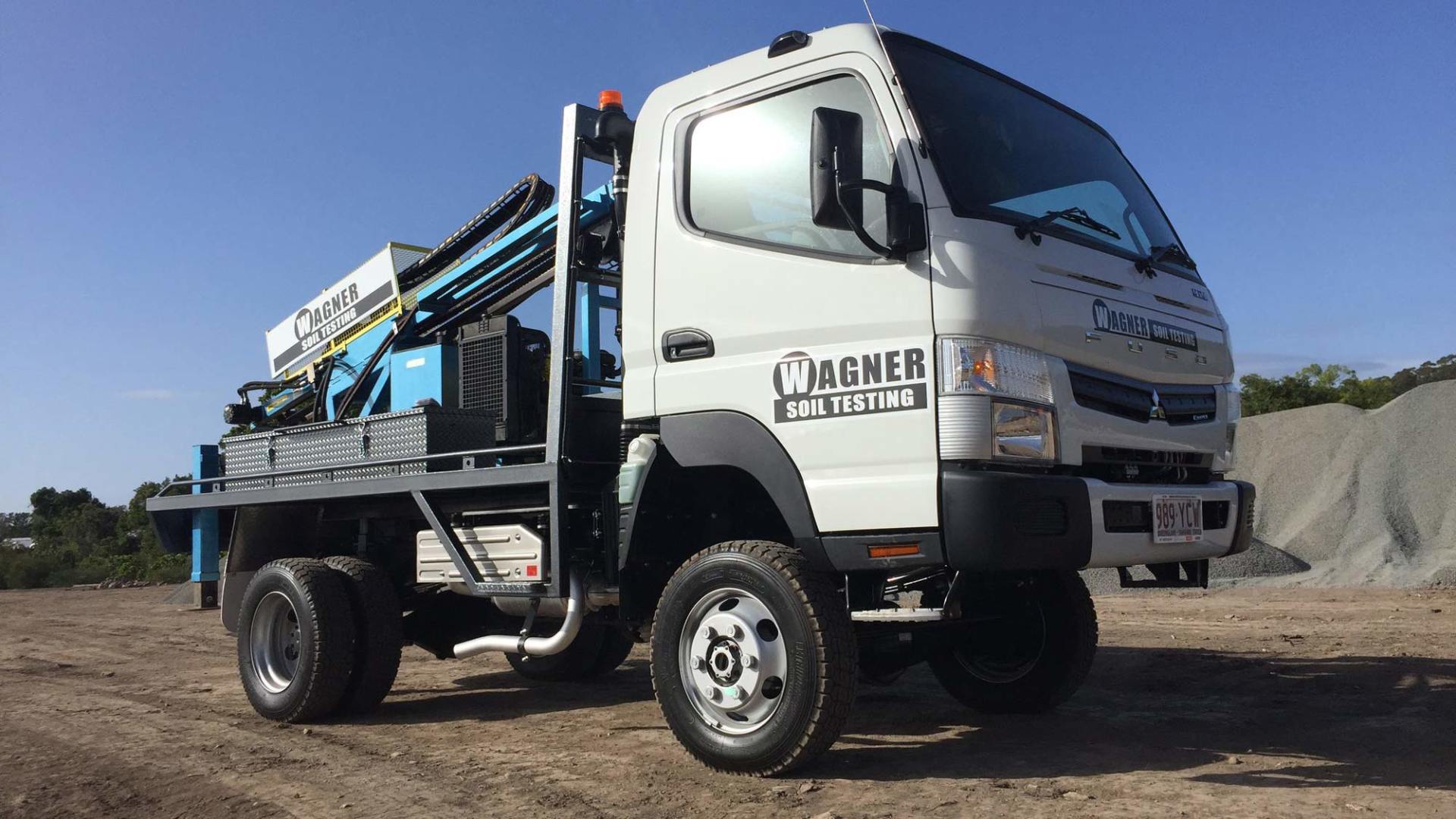
The only way to know your block's actual class is a site-specific test. Wagner drills two 2-metre boreholes near the proposed footing area, runs two adjacent DCP or bearing-capacity tests, then sends the soil to the laboratory for analysis. Because development in the valley is assessed by Ipswich City Council under the Ripley Valley PDA scheme, the report needs to stand up at council and with your certifier - which is why the work runs through Wagner's NATA-accredited laboratory (No. 15070).
The Ripley Valley is planned for up to 48,750 new homes on greenfield land — and every one of those blocks needs its own AS 2870 site classification before an engineer can design the slab.